NEWSLETTER NO. 7: BAGEHOT’S CRITICISM OF MONTESQUIEU
A note
concerning the concentration of powers as discussed by Montesquieu and Bagehot.
|
Introduction |
|
It is worth observing that there is a significant critique of Montesquieu’s doctrine of the division of powers in Walter Bagehot’s English Constitution (published in 1867/1872); it contains a view that is followed by almost every recent writer who has given his attention to politics. Together with Burke, he has outlined a set of views that are needed to define modern conservatism. But the substance underlying their arguments is tawdry and weak and one must observe how much political writing fails to penetrate or disclose the real structure of the state. However, Bagehot also includes a number of interesting comments on the constitution of the USA insofar as it followed Montesquieu’s doctrines. |
|
As Montesquieu says, objective law must be a deduction from the necessity of things. But in practice the source of a deduction may contain prejudiced statements and their implications may persist through to the conclusions. Montesquieu’s text does not develop his original ideas in logical depth; his text is wide-ranging and makes many points outside the necessities in the separation of powers. Yet a major concern of his was to reply to Machiavelli’s arguments for the concentration of power in the ‘Prince’ and in this he followed a line of political thought found in mediaeval Spain and Catalonia in particular. Pro-democratic views have since been developed and followed up by Alan Fox, J K Galbraith and many others in recent years, all of whom see important implications for corporate governance in the doctrines of Montesquieu. |
|
|
|
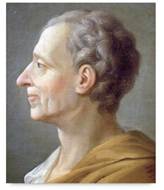
Charles-Louis
de Secondat Montesquieu |
|
|
|
Montesquieu – his analysis |
|
The
sovereign as head of state today, whether monarch or president, should have
limited, but actual, powers. This to
my mind is the fundamental principle that may be derived from
Montesquieu. The effect of
Montesquieu’s analysis is to either divide sovereignty or introduce some
version of the concept of system made up of interdependent parts. Even if sovereignty is not a concept in
general use in American political analysis, yet worldwide the lust after
undivided sovereignty and absolute power is as powerful today as it ever
was. |
|
Yet the sovereignty of parliament is also a
well-worn but widely supported concept.
So, the essential division between parliament and head of state is in
practical terms widely recognised, even if often challenged. Beyond this division, the independence of
the courts – the legal system – is not often challenged; and the division
between central state and local government is also in practical terms
acknowledged. |
|
Montesquieu’s doctrine has been adapted and enhanced since originally
written and taken up for different purposes. Galbraith, for
example, in his discussion of modern American government used the term
‘countervailing powers’ to describe a process where different social
institutions have independent powers as a counterweight to a single dominant
power (such as a corporate monopoly which is a standard form in
USA). |
|
Moreover, when one considers the new global world, the fact that the
division of powers has the effect of denying absolute authority is
fundamental. It is interesting to note here how two other authors
have approached a similar position from a different
direction. Both Adam Smith and Emile Durkheim use the ‘division of
labour’ with wider and deeper implications that parallel our argument. |
|
Following this corporate instance
no-one would expect a business director of finance or product development to
have the knowledge to take over the other’s role. Each to his own specialism. |
|
It is noteworthy that historically France had the benefit of many ‘Parlements’ across its territory based in the major regional cities; yet from the time of Louis XIV to that of Louis XVI, no National Assembly sat. When Montesquieu was writing, there was no institutional opposition to the king tolerated, even though some Dukes, instance Guise, had some independence; but commerce was beyond the king’s control. The regional Parlements, as with Commerce, he probably did not control. |
|
In response to the separation of powers in recent years has emerged the practice of the cumul des mandats in which is found precisely what Montesquieu was opposed to, namely the combination of separate powers or functions in one person. |
|
|
|
Bagehot |
|
In this context, Walter Bagehot’s criticism is of considerable interest. It expresses a view that is widely found throughout the Western world. The separation of powers came under criticism from Bagehot who rejected the principle at least as it applied in the UK. He firstly says that Cabinet Government headed by a Prime Minister and subject to the support of parliament is a centralised form of government and therefore not an instance of the separation of powers; and that the monarch is a ceremonial object only, not a separate and independent power. And this is how the system should be. For the sovereignty of parliament is in itself a check on absolute power, while Montesquieu’s division of powers is not. Further, he says, the effect of Cabinet is to put ministers in charge of the executive so they form a single whole and not two distinct bodies. He also reminds us, which is worthwhile, that Parliament elects the Prime Minister and government, in contrast to the USA where the President is elected by a national vote but chooses his own government. Congress does not select, elect or appoint government, though it may scrutinise appointments. Bagehot says this latter practice is a consequence of the separation of powers and a mistake. But Bagehot pays little regard to the status of the legal system, that is the judiciary, and this is a flaw in his analysis. |
|
Bagehot further asserts that the system should function so as to bind
the different roles together; when binding fails, the constitution is on the
point of breakdown and there is a crisis imminent. The point may
be made that parliament is a system of representation based on
territory. But government should be a system of administration
centred on the objective of the maintenance, development and advance of the
society as a whole. There is a tension between these two functions
which is best recognised and accepted. |
|
Bagehot’s doctrine of Cabinet cohesion scarcely recognises this point;
he sees a fusion of functions of legislature and administration, but not the
tension. This muddles the separation
that is needed. He is very keen on cabinet collective responsibility,
keen on team work, and Cabinet members must all pull together. A UK cabinet draws in divergent interests
so this is understandable. Bagehot
sees cabinet cohesion as part of the shared responsibilities of
government. The same concern for
cohesion also appears in the Federalist Papers especially no. 10 where
criticism is made of the factions and caucuses that are brought about through
democracy. It is I suspect a widely
accepted doctrine in western government.
But it is I believe excessive, a tool of vested interests to maintain
compliance, but it fails completely to recognise, for instance, the
divergence of national interests within the British Isles.. |
|
It is true that a PM appoints his cabinet from MPs none of whom may be
his personal choice, while the President of the USA appoints his cabinet from
where-so-ever, usually academia within his party. Undoubtedly leading lights of politics like
to have their own personal staff. But
though this may assist their own decision making, it goes in the direction of
replacing the Civil Service and challenging the representative character of
democracy. Recent UK PMs, Blair and
Johnson particularly, have sought to enlarge the Cabinet Office so that the
PM has a staff of loyalists. |
|
I tend to conclude that this line of thought is derived from the
USA. Bagehot interestingly makes the
point that at the foundation of the USA, the States maintained a hold on
residual powers not explicitly given to the federation. Slavery was the outstanding example of
retained power; powers over currency in large part were transferred. |
|
One might well conclude that the two-term limit on tenure oi the
presidency was another such restraint on power. This criticism has only recently been expressed
in the USA of the two-term limit, as we all have seen. But my preference is for a life-time
presidency that can be curtailed only by impeachment. The life-time president would be elected by
both chambers of parliament/assembly and the upper chamber would never be
enlarged beyond the size of the representative chamber. The Electoral College established in the US
Constitution is already an efficient electoral body within the ruling class
which has the effect of nullifying the popular presidential vote. |
|
Bagehot makes an interesting criticism of the French system as
embodied in the Third Republic. The chief executive is the
President and he is elected by the Assembly and may be recalled by the
Assembly. He however is not authorised to dissolve the Assembly
and call an election. There is no higher authority to appoint the
President; so, in effect, though this system may look democratic in fact it
reduces the state to immobility. |
|
In the day-to-day developments regarding Brexit and the UK, the
weakness of the doctrine of constitutional monarchy is exposed. Bagehot was perhaps the classic exponent of
this doctrine. In his model, the
constitutional monarch is politically neutral. The veritable head of state is the Prime
Minister. He holds this power in
virtue of the democratic process. The
PM, being the leader of the largest party elected to parliament, is on that
basis the people’s representative. |
|
Bagehot believed that there was a need for a figurehead
sovereign. But the complete denial of
powers to a constitutional monarch yields a false model of people’s or
parliamentary sovereignty. A head of
state with specific and real, but strictly limited, powers is a necessity of
the state system. Any individual who
challenges this or other political role to enlarge his own powers is
threatening the political system of the modern state. |
|
It is clear to my mind that today analysis of the state and government
must be more penetrating: it depends on the concept of system, whose
application here is clear: the component parts to the system are interdependent
and there are three necessary components to the political state, the
president, the parliament and the people; with sovereignty thus divided; yet
the president, retaining a limited sovereignty, as a keystone holds an arch
together. Pace Bagehot, the keystone is not replaceable by a cupola,
a decorative bauble. |
|
It is worth dwelling on this part of Bagehot’s discussion. The reduction of the head of state, as in a
constitutional monarchy, to a ceremonial role as he advocates, does not
create a sound structure; it creates dysfunction; at the very least it fails
to create function. The procedures
surrounding the head of state are essential – as the recent storming of the
Congress in the USA showed. It was
necessary that Congress should meet to ratify the election result. In the UK it is necessary that the head of
state plays a role in the appointment of a PM. It is necessary that the head of state
opens parliament and appoints the Speaker.
But all the rest – the parades in golden coaches, the opening of
flower shows or christening of ships may be trivial, but military displays
probably are not. A re-balance is
needed. |
|
In summary, Bagehot argues in terms of personal qualities. He is keen
to find and support deference and cohesion.
His arguments are largely framed in terms of personal features and
make almost no contact with the requirements of role and function in
administrative structures. He does not
analyse the political system as a structure of roles that have to be learned
through practice and understanding. He
is openly abusive of the outsider who seeks to comment on the body politic.
(See early pages of chapter 7, ‘Its Supposed Checks
and Balances’. |
|
|
|
Conclusions |
|
Pressure to conform has been part of society for at least two thousand
years and more than ever it is over-developed in modern society. It is long overdue that it was brought into
the open and exposed. For modern
political thought, and social thought more widely, has today advanced
further. It is this pressure to
compliance that Bagehot is defending and it is this that Montesquieu is
criticising. Bagehot works under the
rubric of seeking cohesion but the unspoken reality is the demand for
compliance, gained by degrading personal relations. |
|
The Constitution of the USA was a pioneering constitution when Europe
was, largely, over-endowed with monarchies.
(The Tudor state is so remarkable that it is beyond comparison.) Beyond
the creation of an enduring presidential system, its merits lie in the
delineation of the separate structures of government and in the specification
of their unique and limited functions. In this it followed
Montesquieu’s doctrine of the separation of powers. |
|
Let me repeat myself and say again that once nation states become
continental in scope, you do need to use Montesquieu. Separation
of powers, global, continental, regional must be maintained; the structures
and functions must be specified and differentiated. And this point
leads us towards a comparable analysis of the global dimension. |
|
With Montesquieu, this was specified more completely. The sovereign
(with executive), the legislature and the judiciary each have specific powers
and no more. To over-reach your responsibilities and powers is
worse than to fail in your duties. But beyond this the
constitution may not define these powers adequately. In that case
there may be conflict between the different roles. Further
different constitutions in different times may define the roles and functions
differently. The Prime Minister in the UK generally but perhaps
not always selects his cabinet from his party in Parliament; constitutional
preference is from the Commons but from the Lords is a
possibility. The President of the US does not have a Prime
Minister, he is the executive and selects his team, his cabinet, from
where-so-ever within party, usually university or state. Conflict
arose in the late 19th century and subsequently over the powers of the
Supreme Court to over-rule Congress. This involved a distorted
interpretation of the constitution by the judges. |
|
I would sketch out a simple modern model in the following terms. A head of state has limited
responsibilities but they are more than those of a constitutional monarch:
appointment of PM from House of Representatives/Commons; appointment and
oversight of Civil Service and Armed Forces.
PM has responsibility for day-to-day government as long as he has
support of Chamber. Judiciary requires
further analysis for judges may hold lifetime appointments yet they must be
free to scrutinise administrative acts and indeed misconduct by
representatives. Any of these
structures may initiate impeachment proceedings if another exceeds a role’s
defined powers. Upper Chamber must pass scrutiny by lower and must never
exceed lower in size. Both Chambers
together elect life-time Presidency; Armed Forces under President
incompletely; Foreign Policy similarly. The balance of sovereignty may fall
with either Head of State or with Assembly.
The allegiance of Speaker to King or Parliament is negotiable and
controversial. When the English Civil
War began, Speaker Lenthall shifted his allegiance from King to Parliament,
in taking Parliament’s orders; and with the Restoration, Parliament returned
authority to the Monarchy. |
|
PJC |
|
June 2026 |